
Sciatica can affect sitting, walking, sleep and everyday life. Find out when IDD Therapy may help, why an MRI scan is needed, and how to book a free 15-minute Discovery Visit.

Sciatica can be extremely frustrating. For some people, it starts as a deep ache in the lower back or buttock. For others, it feels like a sharp, shooting or burning pain travelling down the leg. It may come with pins and needles, numbness, or a strange “electric” feeling into the calf, foot or toes.
One of the most difficult things about sciatica is that it can affect everyday life very quickly. Sitting can become uncomfortable. Walking may be limited. Sleep can be disturbed. Even simple things like getting in and out of the car, standing at the sink, or bending to put on shoes can become a challenge.
At Chichester Physio, we regularly see people who have been struggling with sciatic pain for weeks, months or sometimes much longer. Many have already tried painkillers, stretches, massage, physiotherapy, chiropractic treatment or injections, but still feel they have not got to the root of the problem.
For some patients, particularly where the sciatic pain is linked to a disc problem in the lower back, IDD Therapy Spinal Decompression may be worth considering.
What actually is sciatica?
Sciatica is a word used to describe pain or nerve symptoms travelling from the lower back into the leg. It usually happens when one of the nerves in the lower back becomes irritated or compressed.
The important thing to understand is that sciatica is not always caused by exactly the same problem. One person may have symptoms because of a disc bulge pressing on or irritating a nerve. Another person may have narrowing around the nerve, inflammation, degenerative changes, or a combination of issues in the lower back.
This is why proper assessment matters. Two people can both say, “I’ve got sciatica,” but the reason behind their pain may be quite different. The right treatment depends on understanding what is actually causing the symptoms.
When might IDD Therapy be considered?
IDD Therapy is a non-surgical spinal decompression treatment. It is designed to gently and precisely reduce pressure through targeted areas of the spine.
At Chichester Physio, we may consider IDD Therapy for patients whose sciatica appears to be linked to a spinal disc problem, especially when symptoms have not settled with more standard treatment.
This might include someone with a disc bulge, disc protrusion, herniated disc, nerve root irritation, or degenerative disc changes where the scan findings fit with the pattern of symptoms.
It is not simply a case of putting someone on a machine because they have back or leg pain. The important question is whether the patient’s symptoms, physical assessment and MRI findings all point towards IDD Therapy being a sensible and clinically appropriate option.
Why an MRI scan is required before IDD Therapy
At Chichester Physio, all patients must have an MRI scan before starting IDD Therapy.
This is an important part of making the treatment as safe and appropriate as possible. An MRI allows us to see what is happening in the spine in much more detail. It can show whether there is a disc bulge, disc protrusion, nerve compression, spinal narrowing, degenerative change, or another issue that may be contributing to the symptoms.
However, an MRI on its own does not tell the whole story. Many people have changes on MRI scans that may not be causing their pain. That is why we always match the scan findings with the clinical picture.
We look at where the pain travels, what makes it better or worse, whether there is numbness, tingling or weakness, how long the symptoms have been present, and whether the MRI findings genuinely fit with what the patient is experiencing.
Having an MRI does not automatically mean someone is suitable for IDD Therapy. It simply gives us the information we need to make a safer and better-informed decision.
If you have not already had an MRI scan, we can discuss this with you during a free 15-minute Discovery Visit. Where appropriate, we can refer you for an MRI scan at no charge for the referral, so that we have the information needed before considering IDD Therapy.
When IDD Therapy may not be the right option
IDD Therapy is not suitable for everyone with sciatica.
If symptoms are very recent and already improving, a more conservative approach may be best. If the pain is not coming from the spine, IDD Therapy would not be appropriate. There are also some situations where further medical advice is needed before any treatment is considered.
This is why we take the assessment stage seriously. The aim is not to offer IDD Therapy to everyone. The aim is to identify the patients who are most likely to be suitable, and to advise honestly if another approach would be better.
Sometimes that may mean physiotherapy, exercise rehabilitation, hands-on treatment, advice, onward referral, or further imaging before any decision is made.
What happens during IDD Therapy?
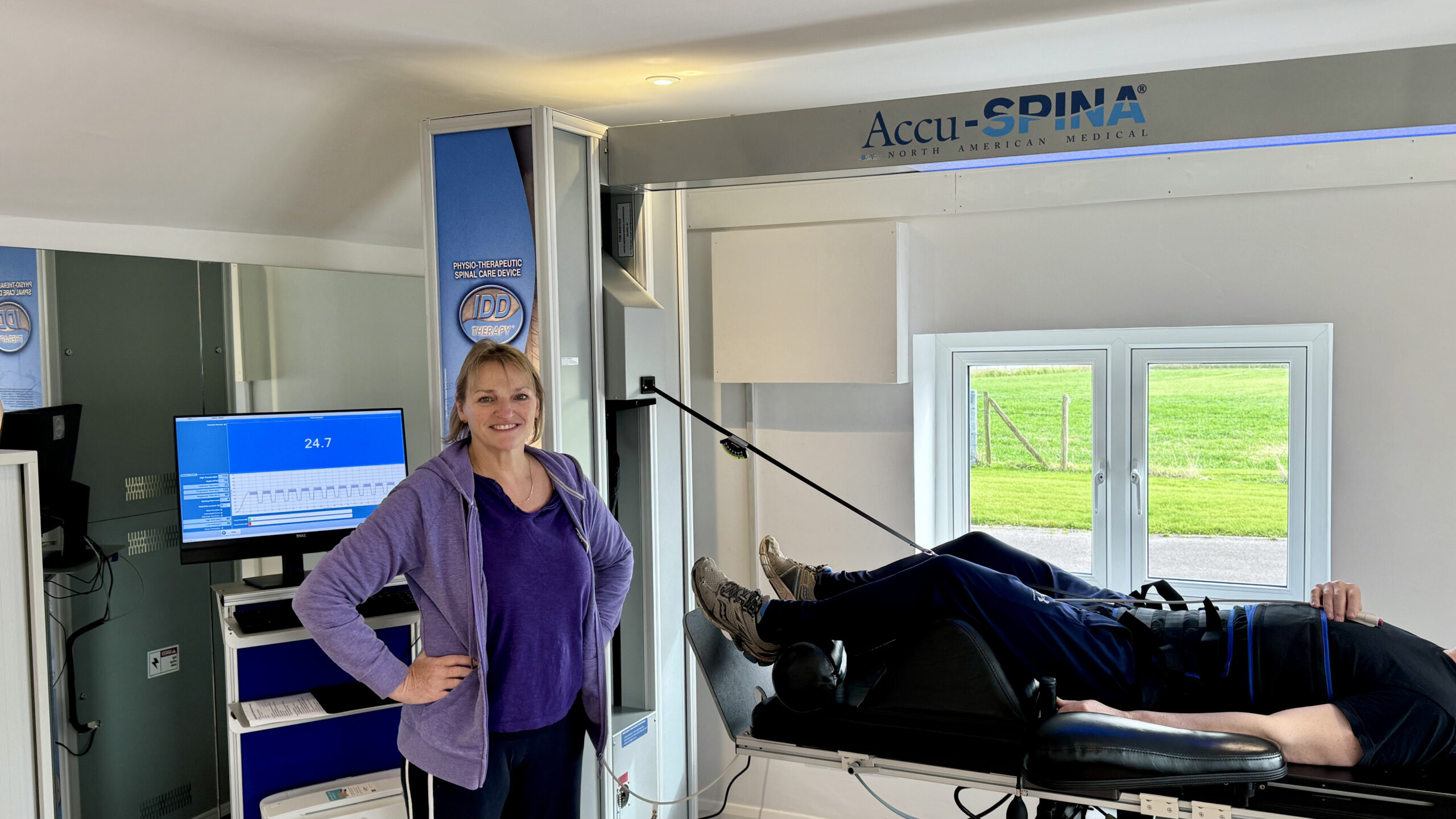
IDD Therapy at Chichester Physio is carried out using the Accu-SPINA spinal decompression system.
Each session starts with a 15-minute heat pack to help relax tense muscles and prepare you for IDD Therapy.
During treatment, you lie comfortably on the machine while the spine is gently decompressed in a controlled and targeted way. The treatment is not designed to be painful, and most patients find the session comfortable and relaxing. Each IDD Therapy treatment lasts 27 minutes.
IDD Therapy is usually delivered as a course of treatment rather than as a one-off session. This is because disc and nerve-related problems often need a structured programme, not just a single treatment.
Optimum results are usually achieved with an initial intensive course of 10 sessions, followed by a more spaced-out second block of 10 sessions.
At Chichester Physio, IDD Therapy is also considered alongside advice, clinical support and a rehabilitation programme. The machine is only one part of the process. The overall aim is to reduce symptoms, improve confidence, and help you move forward towards your goals.
Is IDD Therapy just traction?
This is a common question.
Traditional traction tends to apply a more general pulling force through the spine. IDD Therapy is more controlled and targeted. The aim is to gently decompress a specific spinal level, rather than simply pulling through the whole lower back.
That said, the most important part is still the clinical decision-making. IDD Therapy needs to be used for the right person, with the right diagnosis, and with MRI findings that match the symptoms.
When should you get sciatica assessed?
If your leg pain is mild and improving, you may not need anything more than sensible advice, gentle movement and time.
However, it is worth seeking assessment if your symptoms are not settling, if the leg pain is worse than the back pain, if pain travels below the knee, or if you are getting pins and needles, numbness or weakness into the leg or foot.
It is also worth getting checked if the pain keeps coming back, is affecting your sleep, or is stopping you from walking, working, sitting comfortably or doing normal daily activities.
You should seek urgent medical advice if you develop changes to bladder or bowel control, numbness around the saddle area, severe or worsening weakness, unexplained weight loss, fever, trauma, or symptoms that feel unusual or rapidly worse.
So, is IDD Therapy right for your sciatica?
The honest answer is: it depends on what is causing your symptoms.
If your sciatica is linked to a disc bulge, herniated disc, degenerative disc problem or nerve compression, and your MRI findings match your symptoms, IDD Therapy may be a suitable option for you.
If your symptoms are caused by something else, another treatment approach may be more appropriate.
At Chichester Physio, we can talk through what has been happening, review your history, consider your MRI findings, and advise whether IDD Therapy may be suitable for you.
Book a free 15-minute Discovery Visit
If you are struggling with sciatica and are unsure what to do next, you can book a free 15-minute Discovery Visit with Chichester Physio.
We will listen to what has been happening, explain your options, and let you know whether an IDD Therapy assessment and MRI review may be appropriate. If you have not already had an MRI scan, we can also discuss whether a referral for one would be suitable.
You can also call to speak to our Practice Manager, Richard, who can help assess the best way forward for you. This may be a free Discovery Visit or call, or an initial assessment with one of our experienced specialists to start your IDD journey.
Call Chichester Physio today to find out whether IDD Therapy may be right for your sciatica.
Book a Consultation
It’s easy and free!